By Leonela Fundic
Macquarie University
Over the period from the fourth to the beginning of the eighth centuries, sacred landscapes in the Mediterranean underwent fundamental changes, which were caused by (or were the reflection of) cultural and artistic interactions between different religions and their utopian ideals.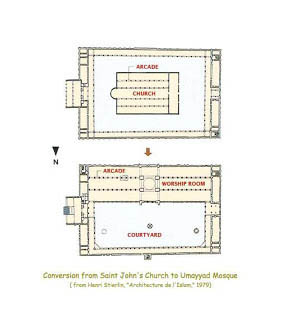
Firstly, the expansion of Christianity and decline of paganism contributed to destruction of local sacral shrines and temples or their transformation into Christian churches. Afterwards, Persian and especially Islamic conquests resulted in even more dramatic and permanent transformations of sacred topography in the same region.
Archaeological research, however, has not produced much evidence for violent destructions of pagan shrines by Christians. Rather, excavations suggest that many pagan temples were abandoned in the pre-Christian period and reused for different purposes, including holding certain festivals, markets and other public events. In some cases, Christians, who regarded themselves as heirs of the classical culture, had great appreciation for the artistic value of pagan monuments. For them this represented a kind of nostalgia for an illustrious and idealised past of the Greek and Roman worlds and a way to connect and return to their perceived classical inheritance.
When Islam appeared as a new religion, offering the idea of fulfilment and perfection of Christianity, Christian sites of worship were reshaped for the purposes of the new faith. However, thanks to the Islamic respect for some Christian cults, despite their conversion to mosques, parts of certain churches retained and continued their previous function as Christian sites of worship.
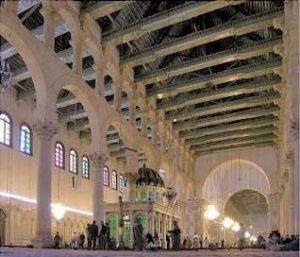
St John’s Chapel Umayyad Mosque. Photo courtesy of Leonela Fundic
A good example for this is the religious site today preserved as Umayyad Mosque in Damascus. It was constructed as a pagan temple; the Christians converted it into a church and when the Arabs prevailed, it was ultimately transformed into a mosque. This reflects, among other things, the belief that each new religion improves upon and is the fulfilment of the promises of the ones preceding it. The sacred places and landscapes of previous religions are thus incorporated into the succeeding/current ritual narrative.
The project intends to shed new light on some aspects of these transformations between the fourth and the eighth centuries to show how religious shrines were used and reshaped to preserve the memory of the past and to create an idealised future. The examination of this phenomenon is based on a diverse set of visual evidence, ranging from archaeological sites, architecture, sculpture and inscription across the Mediterranean. Still, my analysis is focused on several most characteristic examples, such as Mamre (Palestina), religious monuments from Zorava (Syria), the Great Mosque of al-Nuri in Homs, Umayyad Mosque in Damascus, and several less-known inscriptions from Greece.
About the Author:
Leonela Fundic holds a doctorate in Byzantine Art and History from the University of Thessaloniki, Department of History and Archaeology.
Since 2013 she has based her scholarly activities in Australia working for the Centre of Early Christian Studies at Australian Catholic University and for the School of Historical and Philosophical Inquiry at the University of Queensland. In 2017, she joined the Department of Ancient History of Macquarie University (Sydney) to work on the project Memories of Utopia: Destroying the Past to Create the Future. She publishes in the areas of Late Antiquity and Byzantine archaeology, art and history.
Selected Bibliography:
Bradbury, S., “Constantine and the Problem of Anti-Pagan Legislation in the Fourth Century.” Classical Philology 89, no. 2 (1994): 120-139.
Busine, A., “From Stones to Myth: Temple Destruction and Civic Identity in the Late Antique Roman East.” Journal of Late Antiquity 6, no. 2 (2013): 325-346.
Davis, J., “Memory Groups and the State: Erasing the Past and Inscribing the Present in the Landscapes of the Mediterranean,” in Yoffee, N. (ed), Negotiating the Past in the Past, Tucson: University of Arizona Press, 2007, 227-256.
Hahn, J., Emmel, S. and U. Gotter (eds), From Temple to Church: Destruction and Renewal of Local Cultic Topography in Late Antiquity, Leiden and Boston: Brill, 2008.
Roueché, Ch., “From Aphrodisias to Stauropolis.” In J. Drinkwater and B. Salway (eds), Wolf Liebeschuetz Reflected: Essays Presented by Colleagues, Friends, & Pupils. Bulletin of the Institute of Classical Studies, Supplement 91 (2007), 183-192.
Saradi-Mendelovici, H., “Christian Attitudes Toward Pagan Monuments in Late Antiquity and Their Legacy in Later Byzantine Centuries.” Dumbarton Oaks Papers 44 (1990): 47-61.