Bronwen Neil and Kosta Simic (eds.) 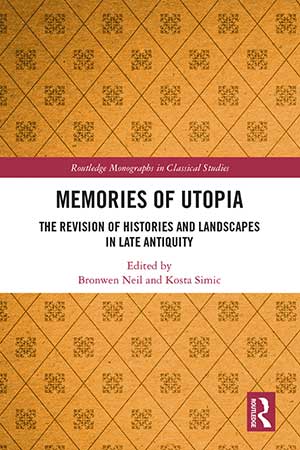
(Routledge; New York, NY: 2020)
These essays examine how various communities remembered and commemorated their shared past through the lens of utopia and its corollary, dystopia, providing a framework for the reinterpretation of rapidly changing religious, cultural, and political realities of the turbulent period from 300 to 750 CE.
The common theme of the chapters is the utopian ideals of religious groups, whether these are inscribed on the body, on the landscape, in texts, or on other cultural objects. The volume is the first to apply this conceptual framework to Late Antiquity, when historically significant conflicts arose between the adherents of four major religious identities: Greaco-Roman ‘pagans’, newly dominant Christians; diaspora Jews, who were more or less persecuted, depending on the current regime; and the emerging religion and power of Islam. Late Antiquity was thus a period when dystopian realities competed with memories of a mythical Golden Age, variously conceived according to the religious identity of the group. The contributors come from a range of disciplines, including cultural studies, religious studies, ancient history, and art history, and employ both theoretical and empirical approaches. This volume is unique in the range of evidence it draws upon, both visual and textual, to support the basic argument that utopia in Late Antiquity, whether conceived spiritually, artistically, or politically, was a place of the past but also of the future, even of the afterlife.
Memories of Utopia will be of interest to historians, archaeologists, and art historians of the later Roman Empire, and those working on religion in Late Antiquity and Byzantium.
“This collection of essays examines the centrality of memory to the making and maintenance of utopian ideals. The editors make a strong case for the importance, and also the fragility of memory in Late Antiquity, noting that the period was marked by a ‘triad of construction-destruction-reconstruction’ (14); a process in which memories were continually made and reimagined. In their conclusion, the editors make some attempts to connect the mutability of memory to contemporary matters, such as the slogan ‘Make America Great Again’. Attempts to reimagine the past take (and took) place in very specific contexts; in relation to late antiquity our knowledge of the context of such reimagining is fragmentary. This book represents a thought-provoking attempt to put some of the pieces back together.” (Hope Williard, Review in Bryn Mawr Classical Review)
The editors of Memories of Utopia—The Revision of Histories and Landscapes in Late Antiquityundertook this research with the aid of a grant from the Australian Research Council for the project Memories of utopia: Destroying the past to create the future(Discovery Project 170104595). The project’s Chief Investigators Bronwen Neil, Wendy Mayer, Pauline Allen and Chris de Wet (Partner Investigator), as well as International collaborators Naoki Kamimura and Robin Jensen, and postdoctoral fellows Leonela Fundic, Ryan Strickler, and Rajiv Bhola, contributed chapters. Early drafts of several chapters were presented at various conferences. These included the Early Christian Centuries conference ‘Early Christian Responses to Conflict’ at Australian Catholic University, Melbourne, in September 2017; the 39th Australasian Society for Classical Studies conference held in February 2018 at the University of Queensland; and the North American Patristics Society meeting held in May 2018 in Chicago.
Contents
Part I: Writing and rewriting the history of conflicts
- Bronwen Neil, Curating the past: The retrieval of historical memories and utopian ideals
- Philip Bosman, Julian’s Cynics: Remembering for future purposes
- Jonathan P. Conant, Memories of trauma and the formation of an early Christian identity
- Geoffrey D. Dunn, Augustine’s memory of the 411 confrontation with Emeritus of Cherchell
Part II: Forging a new utopia: Holy bodies and holy places
- Wendy Mayer, Purity and the rewriting of memory: Revisiting Julian’s disgust for the Christian worship of corpses and its consequences
- Naoki Kamimura, Constructing the sacred in Late Antiquity: Jerome as a guide to Christian identity
- Chris L. de Wet, Utopia, body, and pastness in John Chrysostom
Part III: Rewriting landscapes: Creating new memories of the past
- Bronwen Neil, Memories of peace and violence in the late-antique West
- Pauline Allen and Kosta Simic, Two foreign saints in Palestine: Responses to religious conflict in the fifth to seventh centuries
- Kosta Simic, Remembering the damned: Byzantine liturgical hymns as instruments of religious polemics
- Ryan W. Strickler,Paradise regained? Utopias of deliverance in seventh-century apocalyptic discourse
- Chris Bishop, Ausonius, Fortunatus, and the ruins of the Moselle
Part IV: Memory and materiality
- Robin Jensen, Spitting on statues and saving Hercules’s beard: The conflict over images (and idols) in early Christianity
- Janet Wade, Athena, patroness of the marketplace: From Athens to Constantinople
- Leonela Fundic,Transformation of Mediterranean ritual spaces up to the early Arab conquests
Epilogue
Rajiv K. Bhola